Tiếng Việt
⬇ Download Texturic for SketchUp (.rbz)
Texturic is a SketchUp extension that turns a selected face into real 3D tiles. Pick one of 145 laying patterns (herringbone, chevron, Versailles, brick bonds, hexagon, fish scale, planks, stone, grass pavers, Islamic stars and more) and Texturic models the tiles with thickness, a grout gap and a bevel, clipped to the face and around holes. Each tile gets its own random crop of your photo and a tone variant, and a take-off counts the full and cut tiles you need to buy. In SketchUp you get 10 free uses per UTC day (every feature) with a free 3dshouse account, then Texturic Pro ($120 one-time list price, no seat limit) is a lifetime licence with no daily limit. The web version is free and unmetered.
What Texturic does in SketchUp
- Real geometry, not a picture. Thickness, grout gap, grout recess and bevel. Tiles are clipped to the face and around holes, on faces inside nested groups. Orbit, section and render them like anything you drew.
- A library of 145 laying patterns. Parametric patterns, searchable and filtered by ceramic, stone, wood and brick: herringbone and its double and triple variants, chevron, Versailles, running, stack, English, Flemish and other brick bonds, basketweave, hexagon, fish scale, penny round, grass pavers, Islamic stars, hopscotch, pinwheel, random-length planks, ashlar, cobblestone, flagstone and paver sets. Tile size, angle and grout are parameters.
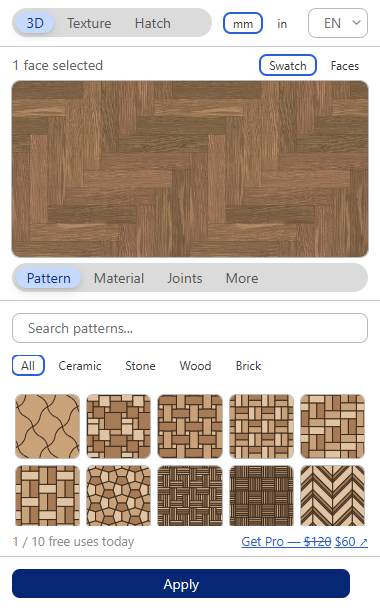
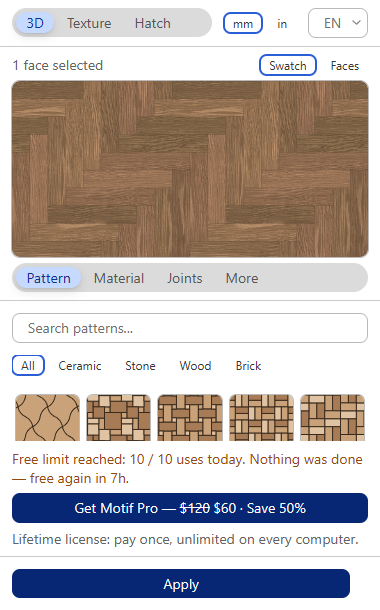
- A seamless swatch preview. The dialog shows the chosen pattern repeated like a sample board, in your material, before you select anything; switch to Faces to see the layout on the selected faces, with cut tiles marked.
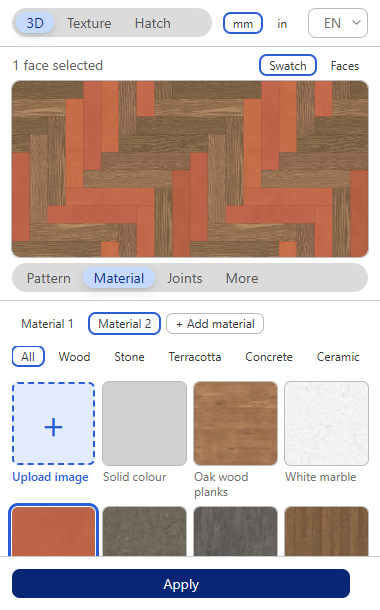
- No two floors alike. Each tile takes a random crop of your photo and a tone shift. Same seed, same floor; a new seed re-rolls it. In the Material tab upload your own image (.jpg or .png), pick a solid colour, or choose one of the included textures; add a second material to give single tiles their own look.
- A take-off. The Takeoff section lists full and cut tiles per tile size, net area, bought area and waste %, and exports a CSV. Change the pattern or the origin and the numbers follow the layout.
- Editable later. The result is one component that stores its settings. Select it, open Texturic, change anything and press Update: it is rebuilt in place as one undo step.
- A lighter model. Uncut tiles share component definitions (the option “Instance full tiles”, on by default). Measured with the Texturic engine on a 5.4 x 5 m herringbone floor with 5,154 tiles: 46,387 faces as raw geometry against 576 faces in 64 shared definitions plus 4,837 instances and 2,854 raw faces for the cut tiles and grout bed.
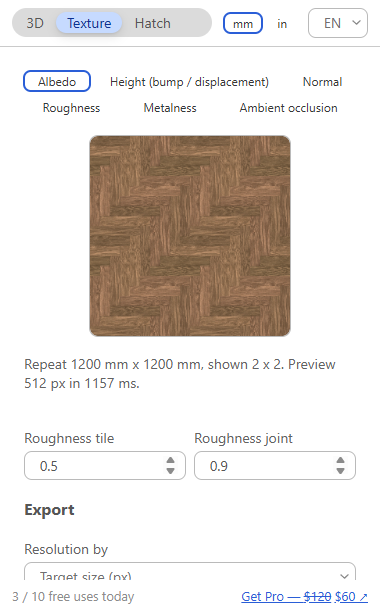
- Textures and CAD hatches. Save the same pattern as seamless albedo, height, normal and roughness maps (one .zip) or apply it to the selected faces as a material; in SketchUp 2025 and newer the material also carries the normal, roughness, metalness and ambient-occlusion maps (PBR). Export hatches as AutoCAD .pat, Revit model and drafting .pat, SVG or DXF.
How to tile a floor in SketchUp with Texturic
- Click a face with the Select tool (or select several faces).
- Open Texturic from the Extensions menu or its toolbar button and sign in with your free 3dshouse account.
- In the Pattern tab search or filter the 145 patterns and click one; the swatch above shows it repeated in your material.
- In Material upload your own image, pick a solid colour or a texture. Joints sets the grout and its recess; More holds tile thickness, angle, seed, edge profile and bevel.
- Press Apply. Texturic builds the tiles inside SketchUp.
- Scroll to Takeoff to read the full and cut counts and waste, and press Export CSV for your order.
- To change it later, select the tiled component, open Texturic, edit and press Update.
Free and Pro
| Free | Texturic Pro | |
|---|---|---|
| Price | $0 | $120 one-time list price (the checkout shows the current sale price) |
| Uses | 10 per UTC day | Unlimited |
| Features | All of them | All of them |
| Account | Free 3dshouse account | Same account; works on every computer you sign in to, no seat limit |
One use is one result delivered into SketchUp or saved to disk: Apply or Update, applying the texture as a material, saving the texture maps, or saving a hatch. Browsing patterns and previewing cost nothing. The count resets at midnight UTC, not 24 hours after your first use. Pro is a lifetime licence tied to your account, and it activates by itself the next time you use Texturic signed in.
Try the patterns in your browser first
The Texturic web tool runs the same dialog in a browser, with a simulated model, so you can try patterns before installing anything; the web version is not metered. The pattern pages, the hatch (.pat) page and the tile calculator are there too.
How Texturic differs from other SketchUp tile tools
| Texturic | Architextures | Oob Layouts | Curic Face Array | |
|---|---|---|---|---|
| Result in SketchUp | Real 3D tiles from a face | A material (texture) from its plugin | 3D layouts on faces | Copies of a component you made |
| Patterns | 145 parametric | Large texture library | Rectangular layouts | Not a pattern library |
| Different crop per tile | Yes (random crop + tone variants) | Within one texture repeat | Random colours and sizes | No, every copy is identical |
| Take-off | Full / cut, area, waste, CSV | Not listed | Full and cut counts | Not listed |
| Price | 10 free uses a day; Pro $120 one-time list price | Free tier; Pro NZ$119.99 per year | Paid, with a trial | Free |
Competitor facts come from the vendors’ own pages as read on 2026-10-10 (Architextures, Oob Layouts on the Extension Warehouse, Curic on Gumroad); “not listed” means the page does not list it, not that the product cannot do it. Check each vendor for current details. Building a tile array by hand instead? See the Dynamic Components tile floor tutorial.
Install
- Download Texturic .rbz.
- In SketchUp, open the Extension Manager, click Install Extension and choose the downloaded file.
- Restart SketchUp. Texturic appears in the Extensions menu and as a toolbar button.
Requirements
- SketchUp 2022 or newer.
- A free 3dshouse account to sign in. In SketchUp every feature has 10 free uses per UTC day; Texturic Pro ($120 one-time list price) removes the limit.
- An internet connection: the dialog loads from texturic.3dshouse.com.
FAQ
Is Texturic free?
Partly. In SketchUp every feature works for 10 free uses per UTC day with a free 3dshouse account, no licence key; after that, Texturic Pro (one-time purchase, list price $120) is needed. The web version is free and unmetered.
What counts as one use?
One result delivered into SketchUp or saved to disk: building or updating the tiles, applying the texture as a material, saving the texture maps, or saving a hatch. Browsing patterns and previewing cost nothing, and the web version is not metered.
When does the free limit reset?
At midnight UTC, not 24 hours after your first use. The dialog shows how many hours are left when the limit is reached.
Does Texturic make real 3D tiles or just a texture?
Real geometry: each tile has thickness, a grout gap and a bevel, clipped to your face and around holes. It can also save seamless texture maps and apply one as a material, but the tiles are modelled.
Is every tile really different?
Each tile gets a random crop of your photo and one of several tone variants, chosen from a seed. To keep the model light, uncut tiles share component definitions by default (the option “Instance full tiles”), so the number of distinct looks is limited by the crop slots per tone variant; cut tiles each get their own crop. Switch instancing off if you want every tile unique.
Does it work on faces with holes or inside groups?
Yes. Select one or more faces, including faces with holes and faces inside nested groups; the tiles are clipped to the boundary and around the holes.
Does it count the tiles I need to buy?
Yes. The Takeoff section lists full and cut tiles per tile size, net area, bought area and waste percent, and exports a CSV.
Can I edit the floor after generating it?
Yes. The result is a component that stores its settings. Select it, open Texturic, change the pattern, grout, seed or anything else and press Update; it is rebuilt in place in one undo step.
Can it tile a roof?
Roof tiles are not part of the current version.
Which SketchUp versions are supported?
SketchUp 2022 and newer. The dialog loads from texturic.3dshouse.com, so it needs an internet connection.