Tiếng Việt
SketchUp
Heavy SketchUp File? The 5 Real Causes — and the Fix That Actually Works
A SketchUp file gets heavy for five different reasons, and Purge Unused fixes exactly one of them. That is why a model often shrinks on the first purge and then refuses to get any lighter: whatever weight is left is still referenced — high-resolution textures, high-poly imported geometry — and purging never touches anything that is in use. Below are the causes in the order worth checking, each with the fix that actually moves it, so you can reduce SketchUp file size instead of guessing.
How to Optimize Heavy SketchUp Files and Reduce Lag: Video Tutorial
Read two numbers before you change anything
Open Window > Model Info > Statistics. SketchUp describes that pane as the one that “keeps track of all the entities your model contains”, where you also “find tools for purging unused entities and fixing some common problems”.
- Note the file size on disk, click Purge Unused, save, then look again. A big drop means your problem was unused assets, and you are already done.
- Note the edge and face counts. If they are still high after purging, your problem is geometry, and no cleanup command will fix it.
Those two numbers split the whole problem in half, and they stop you installing a purge plugin for a model that is heavy because somebody dropped a 3D scan into it.
Cause 1: unused components, materials, tags and styles
SketchUp’s own help states the mechanism: “Your model stores all the components, styles, and materials you’ve added while modeling even after you’ve erased or replaced them.” Nothing in the viewport shows them, so the file grows silently through a long session, and every model you import adds its own: unused imported components keep their definitions in the file too.
The native command is Window > Model Info > Statistics > Purge Unused, which drops the components, tags, styles and materials that nothing in the model references any more. Three things about it are worth knowing:
- Run it more than once. Order matters, and SketchUp’s own guide says so: delete components first, then tags, then materials, and “Repeat process for any subcomponents that were left behind.” A component dropped in the first pass orphans the materials and sub-definitions it referenced, and those only become purgeable on the next pass.
- SketchUp 2025 asks you at save time. From the release notes: “By default, a reminder will now appear when saving a file asking if you would like to purge unused assets, preventing model bloat.” You can silence it with Don’t Ask Again or in the General section of Preferences — but the same notes explain why it exists: 2025’s “new Photoreal Materials are significantly larger than the materials in previous versions”.
- A small white triangle marks a material that is in use. In the Materials panel that corner marker is the fastest way to see what a purge will take and what it will leave, before you run anything.
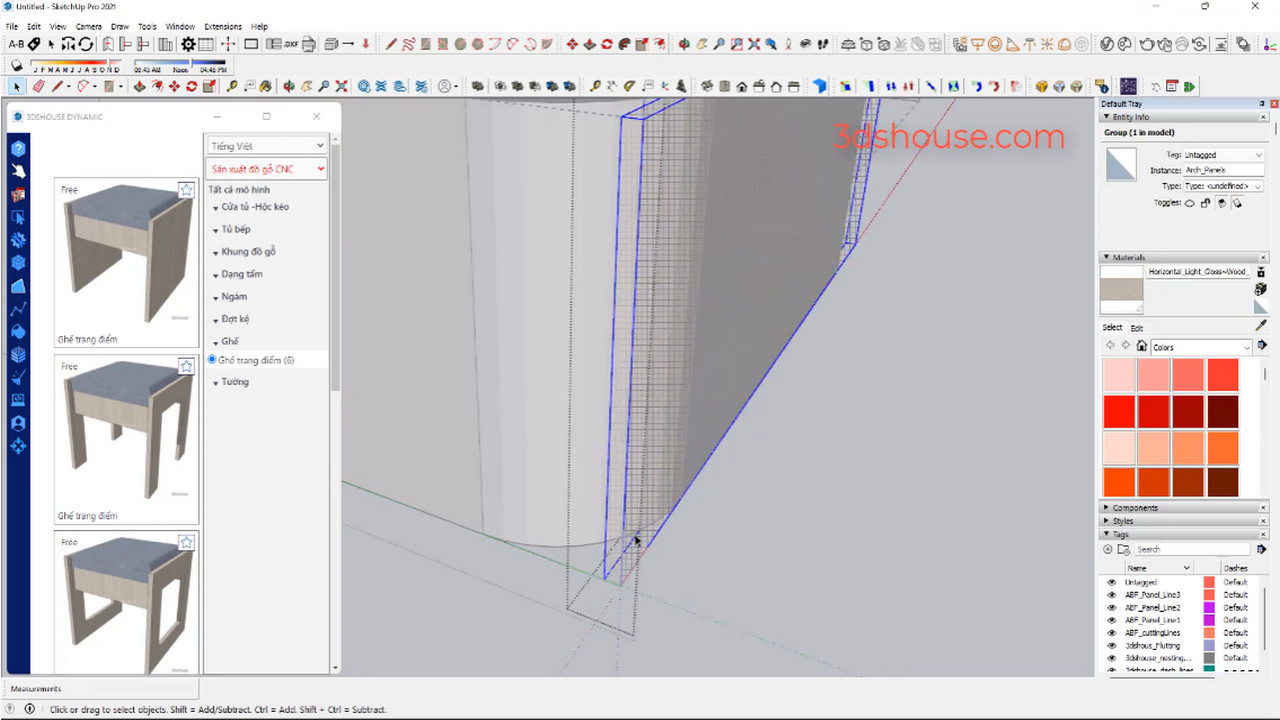
The one-click version of the same chain is the Purge Unused tool shown in the video above.
Cause 2: texture resolution, the weight purge cannot reach
A texture painted on a face is in use, so purge leaves it alone however large it is. SketchUp publishes the figure that settles the argument: “A material at a 2048 x 2048 resolution is 2.4Mb. The same material at a 320 x 320 resolution is only 176K.” In most models the two look identical on screen.
- Edit the material in the Materials panel and lower its resolution. The official advice is to “reuse materials and textures where you can, and reduce the resolution of the images you import”.
- Swap heavy image formats for compressed ones: “While TIFF files are high quality, they also tend to be larger files and take more resources to display. Try using an image in JPEG format instead.” A large TIFF terrain image is the classic single-file offender.
- CleanUp³’s Merge Identical Materials collapses materials that are identical apart from their metadata, and by default it does ignore that metadata — which its own tooltip warns “Might include render engine data”, so check that before merging on a V-Ray or Enscape scene.
Cause 3: polygon count, where purge and cleanup stop helping
“Every face adds to the file size of the model,” and “the more edges, faces, and materials you have in a model, the more resources SketchUp needs to use.” A file whose weight is geometry cannot be purged lighter, because that geometry is placed and in use.
Where it comes from, in rough order of frequency: 3D Warehouse furniture, 3D scans, meshes imported from 3ds Max or Blender, and your own curves — SketchUp is blunt about the last one, “Reducing segments on arcs and circles is the easiest way to reduce your polygon count.”
Be exact about what a cleanup extension can do here. CleanUp³’s Merge Coplanar Faces “removes edges separating coplanar faces”, which is ideal for imported CAD surfaces sliced into strips and useless on a curved sofa, because none of those triangles are coplanar. Reducing a curved or organic mesh means collapsing real geometry — decimation, not cleanup.
That is the step Decimify runs inside SketchUp: select one group or component, pull a slider, commit the result back. What matters in practice:
- The slider is a target triangle-count ratio applied per sub-mesh, not a scene-wide budget. Ten objects at 50% each get 50%.
- Committing onto the selection refills that ComponentDefinition in place, so every instance of it in the model updates at once, and the whole commit is a single Edit > Undo however long it ran.
- Four settings: Lock boundaries, Preserve creases, Maintain UV, and Smooth angle (°), which decides the soft/smooth edge state written back into SketchUp.
- If the slider barely moves on a textured 3D Warehouse model, turn Maintain UV off. When a texture is pinned per face — typical of upholstery — every corner carries its own UV slot and Decimify will not reduce across them. With Maintain UV off it reduces freely and the texture is re-mapped per face.
- Free covers every feature at every reduction level with a free 3dshouse account, metered at 3 exports or commits per UTC day. SketchUp 2022 or newer.
“Reduce SketchUp file size online” — what a browser can actually do
No browser service takes a .skp and hands back a lighter .skp. What works online is mesh level: export the heavy part, reduce it, bring it back.
- Export with File > Export > 3D Model and choose GLTF Binary File (*.glb) to carry materials and textures, or STereoLithography (.stl) for bare geometry — leave STL on Binary, the format that “helps reduce the size of an STL file”. Both are built into SketchUp, no extension needed.
- Reduce it in the tab: Decimify Online accepts GLB and STL and runs as WebAssembly in the page, so the mesh itself is never uploaded (the page and the sign-in do need internet).
- Bring the result back with File > Import, or skip the round trip and use the SketchUp extension, which reduces the selected component where it stands.
Cause 4: stray, duplicate and broken geometry
This weight is small, but it is what makes a model misbehave. CleanUp³ (Thomas Thomassen, version 3.4.6, free, MIT-licensed, requires TT_Lib²) is the standard pass, with a Scope of Model, Local or Selected so you can clean one component instead of the whole file. Its own tooltips describe the work:
- Erase Stray Edges — “Removes all edges not connected to any face.” On by default.
- Repair Split Edges — on by default; repairs edges that were split into fragments.
- Erase Duplicate Faces — off by default, and the tooltip says why: “Warning: Very slow!” Use it only when you know faces overlap.
- Erase Hidden Geometry, Geometry to Layer0, Merge Coplanar Faces, Merge Identical Materials, plus Smooth Edges by Angle.
The option nobody reads is the one that saves models. CleanUp³’s “Validate Results” runs SketchUp’s own validation tool after cleaning, and its tooltip adds “(Windows only. OSX users should run Fix Problems manually.)” That validation is the Fix Problems button sitting beside Purge Unused in Model Info > Statistics — a repair pass for invalid geometry, and frequently the real answer to crashes and odd errors that no amount of purging changes. Install steps and every setting are in the CleanUp³ setup guide.
For geometry that is merely lost rather than broken, SketchUp’s 3D Warehouse guide gives the drill: turn every tag on, toggle Hidden Geometry, Zoom Extents, then delete the strays sitting a kilometre from the model.
Cause 5: the file is fine, the display is heavy
If orbiting stutters but the file size is ordinary, nothing needs deleting. Straight from SketchUp’s performance guide:
- “Disable fog and shadows. Special effects like fog and shadows give SketchUp more work to do and aren’t really necessary if you are still drawing or editing your model.”
- “Stick to simple styles” — keep two, a plain one for modelling and a heavy one for presentation.
- “The more visible geometry the slower SketchUp will run.” Park detail on tags and switch them off while you work.
- “Multiple instances of a component are lighter weight than multiple copies of an entity or group,” so copy components rather than loose geometry or groups.
What does not work is hiding edges. “Avoid turning off or hiding edges. This will not simplify the geometry because the edges are still there,” and “any geometry that’s hidden is still there. You just can’t see or select it.” Hiding buys drawing speed, never file size and never face count.
Which fix for which cause
| What you see | Real cause | Fix |
|---|---|---|
| File shrinks a lot on the first purge | Unused components, materials, tags, styles | Purge Unused, run twice |
| File still huge, face count modest | High-resolution textures in use | Lower material resolution; JPEG/PNG instead of TIFF |
| Face count huge and stays huge | High-poly imports, scans, organic meshes | Decimate the mesh (Decimify) |
| Flat imported surfaces cut into strips | Redundant coplanar edges | CleanUp³ Merge Coplanar Faces |
| Stray edges, overlapping faces | Leftover modelling debris | CleanUp³ Erase Stray Edges / Erase Duplicate Faces |
| Slow orbit, normal file size | Display load: shadows, textures, visible geometry | Shadows and fog off, modelling style, hide with tags |
| Crashes, errors, geometry acting wrong | Invalid geometry | Fix Problems, in Model Info > Statistics |
FAQ
How do I purge a SketchUp file?
Open Window > Model Info > Statistics and click Purge Unused. It removes unreferenced components, tags, styles and materials. Run it a second time: a component removed in the first pass orphans the materials and sub-definitions it referenced, and those only become purgeable afterwards. In SketchUp 2025 and newer the same prompt appears every time you save, unless you turned it off in Preferences.
What does purge unused mean in SketchUp?
It deletes definitions the model still stores but no longer uses. SketchUp keeps every component, style and material you ever added, even after you erased or replaced it, so those definitions sit in the file invisibly. Purging drops them. It never deletes anything that is placed, painted or active, so it cannot reduce your polygon count.
How do I make a SketchUp file lighter?
Work through the causes in order: purge unused assets, lower the resolution of the textures that are actually in use, reduce the triangle count of imported or organic meshes with a decimation tool, then run CleanUp³ for stray edges and duplicate faces. If the file size is normal and only the viewport is slow, turn off shadows and fog and hide detail with tags instead of deleting anything.
Can I reduce a SketchUp file size online for free?
Not the .skp itself — no browser service reads and rewrites SketchUp’s own format. What works online is mesh reduction: export the heavy part with File > Export > 3D Model as GLB or binary STL, reduce it in a browser tool such as Decimify Online, then import it back. The reduction runs in the page as WebAssembly, so the mesh is not uploaded to a server.
Is there a SketchUp plugin to reduce file size?
Several, and they fix different causes. A purge tool clears unused definitions. CleanUp³ erases stray edges, repairs split edges and merges coplanar faces. Neither reduces a curved mesh, so for high-poly imports and 3D Warehouse furniture you need a decimation extension such as Decimify, which reduces the selected group or component in place inside SketchUp.